.png)
Large Group Boat Tour Guide for Event Organizers

For most organized events, book a private charter once your group needs exclusive use, flexible timing, or seating for roughly 20 or more people. Block-booking scheduled tickets works when your group is price-sensitive and small enough to fit without displacing other passengers.
Before you call any operator, get three things straight:
Ask first: What is the vessel’s maximum capacity, what is your final headcount policy, and how much is the deposit?
Book now: Contact operators with your preferred date window and a rough headcount. Availability for weekend dates fills fast, especially in summer.
Avoid this: Skipping pre-boarding instructions. Pre-boarding communication is the most commonly overlooked step. Charters run on fixed schedules, and late arrivals eat into non-refundable time.
Operators worth trusting carry USCG-licensed captains, assign dedicated event coordinators for large parties, and publish clear capacity limits. Affordable Crab Island Tours, based in Destin, Florida, checks all three and handles groups up to 31 passengers on a single guided vessel.
Table of Contents
What vessel capacity actually means for your group size
“Large group” is a relative term. Most operators draw the line around 30 passengers per vessel, which is where single-boat logistics get complicated and multi-boat solutions start making sense.
Group Size | Typical Vessel Fit | Key Considerations |
— | Single small vessel | Easy to book; most scheduled tours accommodate this |
— | Single mid-size vessel | Confirm restroom availability and seating layout |
32–50 | Single large vessel or two smaller boats | Ask about onboard restroom and crew-to-guest ratio |
— | Multiple vessels in convoy | Requires coordinated captains and pre-arranged docking |
Once you cross around 30 passengers on a single boat, comfort drops fast. Seating gets tight, restroom access becomes a bottleneck, and the crew’s ability to manage safety briefings for everyone at once gets harder. Multi-vessel convoy arrangements solve the capacity problem but introduce a new one: synchronized captain logistics and pre-arranged docking plans become non-negotiable.
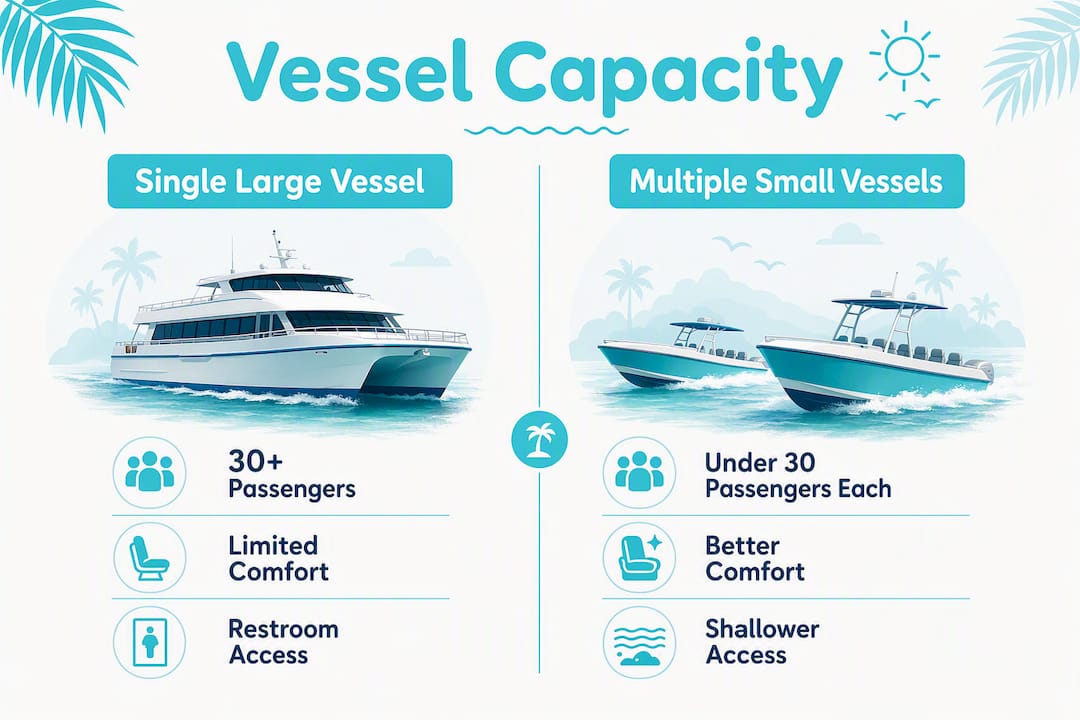
Two smaller boats can actually outperform one large vessel at certain docks. Smaller vessels access shallower anchorages, which matters at destinations like Crab Island in Destin where the sandbar is the whole point.
How do you choose between block-booking and a private charter?
These are genuinely different products, not just different price points.
Block-booking a scheduled tour means purchasing a block of tickets on a public departure. You share the vessel with other passengers, the itinerary is fixed, and the operator controls the music, pace, and stops. It works well for price-sensitive groups under about 20 people who do not need exclusivity and are flexible about timing.
A private charter means you hire the entire vessel for your group. You set the departure time (within the operator’s availability), control the onboard environment, and can often customize the itinerary, music, and catering. Private events give organizers full control of music, activities, and the venue, which eliminates the unpredictability of shared public cruises.
Work through this decision in order:
Headcount: Is your group over 20–25 people? A private charter almost always makes more sense financially and logistically once you hit that range.
Exclusivity: Does your event require a private atmosphere (corporate client entertainment, bachelorette, rehearsal dinner)? Private charter only.
Customization: Do you need a specific departure time, a custom menu, or a particular itinerary stop? Private charter.
Budget: Is per-person cost the primary constraint and the group is under 20? Block-booking may work.
Alcohol and catering: Many scheduled tours are BYOB or dry. Private charters typically allow beverage packages or BYOB with advance notice.
When you reach out to an operator for the first time, give them your preferred date and time window, a rough headcount (even a range is fine), the event type, and any must-have inclusions like a restroom or sound system. That one email or call cuts the back-and-forth in half.
What does a group charter actually include?
Inclusions vary more than most organizers expect. Here is what is standard versus what costs extra.
Common inclusions on most private charters:
USCG-licensed captain and trained crew
Pre-departure safety briefing and life jackets for all passengers
Onboard restroom (confirm this explicitly for vessels over 30 passengers)
Basic sound system with Bluetooth or aux input
Designated boarding area and crew assistance at the dock
Frequently available as add-ons:
Catering packages or onboard food service
Open bar or pre-purchased beverage packages
Snorkeling gear, floats, or water toys
Custom décor or event signage
Extended cruise time beyond the standard duration
Inclusion | Corporate Event | Family Reunion | Bachelor/Bachelorette |
Onboard restroom | Critical | Critical | Important |
Sound system | Important | Nice to have | Critical |
Catering/bar package | Often pre-included | Popular add-on | Critical |
Snorkel gear/floats | Rarely needed | Popular | Popular |
Event coordinator | Recommended | Optional | Recommended |
A few items catch organizers off guard. Fuel surcharges are common on longer charters and are sometimes listed separately from the base rate. Overtime fees kick in the moment you run past your contracted end time, and they are rarely cheap. Municipal dock fees and special event permits (for amplified music near residential areas, for example) may fall on the organizer rather than the operator. Ask about all three before you sign anything.
How pricing, deposits, and tipping work for large-group charters
Most private charters use one of three pricing models: a flat charter fee for the vessel regardless of headcount, a tiered rate based on guest bands, or a per-person rate with a minimum. Tiered pricing is common, with rates structured around guest count ranges and additional hourly fees for extended time.
Typical line items to budget for:
Base charter fee (covers the vessel, captain, and standard crew for the contracted duration)
Fuel surcharge (often a flat add-on, especially for longer routes or larger vessels)
Beverage or catering package (priced per person or as a flat package fee)
Overtime rate (per 30 minutes or per hour beyond the contracted end time)
Gratuity (typically 15–20% of the base charter fee, paid separately unless pre-included)
Tipping guidance: The industry standard for boat charter crew gratuity runs a moderate percentage of the base charter fee. For corporate bookings, request that gratuity be included in the contract upfront. It simplifies expense reporting and means no one is scrambling for cash at the dock.
Deposits typically run 25–50% of the total charter cost and are due at booking. Most operators require the balance 7–14 days before the event. Cancellation policies vary widely: a 30-day cancellation window for a partial refund is common, but some operators are stricter on peak-season dates. Get the cancellation terms in writing before you pay anything.
Many operators accept a minimum headcount at booking and allow you to adjust the final guest count up to 7–14 days before departure. That flexibility matters when you are managing RSVPs for a large event.
Your planning timeline and pre-event checklist
The single biggest mistake organizers make is starting too late. Here is the milestone sequence that keeps everything on track.
3–6 months out: Send initial inquiries to operators. Confirm vessel capacity, available dates, and whether the operator assigns a dedicated event coordinator. Request a sample contract.
8–10 weeks out: Finalize your operator choice, pay the deposit, and sign the contract. Confirm the cancellation and weather policy in writing.
4–6 weeks out: Share the event itinerary with your group. Collect signed waivers and any required manifest information (full legal names, sometimes ages and weights for smaller vessels).
7–14 days out: Submit your final headcount and pay the remaining balance. Confirm the boarding location, parking options, and any accessibility needs with the operator.
48–72 hours out: Send a reminder to your group with the exact meeting point, arrival time, and what to bring. Specify that the boat departs on schedule.
Day of: Arrive at the dock at least 30 minutes before departure. Some operators, like the Chicago Architecture Center River Cruise, publish exact dock locations and recommend arriving 30 minutes early as standard practice.
Pre-boarding checklist:
Confirmed manifest or guest list with the operator
Signed waivers collected from all participants
Accessibility needs communicated to the crew
Transport and parking logistics confirmed for the group
Emergency contact information shared with the event coordinator
Pro Tip: Set a hard arrival window 20 minutes earlier than the operator’s stated boarding time. Tell your group the boat leaves at that time. Late arrivals are the number-one source of lost charter time, and you cannot get those minutes back.
For corporate groups, coordinate group transportation to the dock in advance. A staggered shuttle schedule from the hotel or office prevents the dock from becoming a bottleneck right before boarding.
How to vet an operator before you book
Not every operator advertising “large group tours” has the crew, vessel, or systems to actually deliver one well. Here is what to ask and what to watch for.
Questions to ask in your first call or email:
What is the vessel’s certified passenger capacity, and what is the layout (seating, standing, restroom location)?
Is the captain USCG-licensed? Can you provide the vessel’s documentation number?
Do you assign a dedicated event coordinator for large bookings?
What is your inclement weather policy, and who makes the call to cancel or reschedule?
What insurance does the operator carry, and does it cover passenger liability?
What is your final headcount policy and payment deadline?
Can you provide a sample contract and references from a recent large-group event?
Red flags that should give you pause:
No written contract or vague cancellation language (“we’ll work something out”)
Inability to name the captain or confirm USCG licensing
Non-refundable deposits with no weather or force-majeure clause
No photos of the actual vessel or unwillingness to share them
Unusually low pricing with no itemized breakdown
No dedicated point of contact for event logistics
Operators who list a dedicated coordinator and USCG-licensed captain in their “what’s included” section are signaling they have handled big events before. That is not marketing; it is a logistics capability. Verify it by asking for a reference from a group of similar size.
What event types work well on a large-group boat tour?
Boats are genuinely versatile event venues, but some formats work better than others.
Event types that translate well to the water:
Corporate team building and client appreciation: The shared experience of being on the water creates conversation naturally. Add a catering package and a sound system and you have a self-contained event.
Weddings and rehearsal dinners: Sunset charters are popular for a reason. Confirm noise ordinances and alcohol permits well in advance.
Family reunions: Multi-generational groups need accessible boarding, onboard restrooms, and shade. Floats and snorkel gear add activity for kids.
Bachelor and bachelorette parties: Music, beverages, and a private atmosphere are the priorities. Confirm the operator’s BYOB or bar-package policy.
School and senior groups: Accessibility and safety briefing quality matter most. Ask about boarding ramp availability and crew-to-passenger ratios.
Customization ideas by event type:
Staggered boarding for large groups (especially useful for senior or accessibility-focused events)
Multi-boat convoys for groups over 50, with coordinated stops at the same anchorage
Onboard catering menus tailored to dietary restrictions, confirmed 2–3 weeks out
Custom music playlists or live acoustic performance (confirm sound system specs first)
Itinerary stops at snorkeling sites, sandbars, or scenic landmarks
A few practical constraints to keep in mind: noise regulations near residential waterways often limit amplified music after a certain hour. Alcohol service on the water is subject to state and local rules, and some operators require a licensed bartender for open-bar packages. Vessel stability limits certain activities (paddleboarding off the side, for example) depending on the boat type and sea conditions.
Why Affordable Crab Island Tours works for Destin groups
Affordable Crab Island Tours is a strong fit for groups of up to 31 passengers looking for a guided, stress-free outing at Crab Island in Destin, Florida. The package covers what most groups actually need: experienced captains, floats and snorkel gear included, an onboard restroom, and comfortable seating. You show up; the crew handles the rest.
For Destin organizers, the booking process starts at crab-island-tours.com. When you reach out, include your preferred date, your group size (up to 31), and whether you have any specific needs (accessibility, BYOB questions, timing). The team can confirm availability and walk you through what is included.
The 4-hour guided format is well-suited to family reunions, friend groups, and casual corporate outings where the goal is a relaxed, memorable day rather than a highly programmed event. BYOB is welcome, floats are in the water before you anchor, and the captain manages the logistics so the organizer can actually enjoy the trip.
Key Takeaways
Private charters are the right call for most organized events once your group exceeds roughly 20–25 people, needs exclusivity, or requires a customized itinerary.
Point | Details |
Book early | Contact operators 3–6 months out for peak-season weekend dates; availability goes fast. |
Confirm the headcount policy | Many operators accept a minimum at booking and allow final adjustments 7–14 days before departure. |
Budget for hidden fees | Fuel surcharges, overtime rates, and gratuity (15–20% of base fee) are common add-ons beyond the charter price. |
Vet the operator carefully | Confirm USCG-licensed captain, written contract, and weather/cancellation policy before paying a deposit. |
Crab-island-tours for Destin groups | Affordable Crab Island Tours handles groups up to 31 with guided tours, floats, onboard restroom, and experienced captains in Destin, Florida. |
What operators actually know that most planners miss
The conventional wisdom on large-group boat tours focuses almost entirely on price per person and total capacity. Those matter, but they are not where events go wrong.
Events go wrong in the 30 minutes before boarding. A group of 28 people arriving in three separate rideshares, none of them sure where the dock is, two of them late, one person who did not sign the waiver — that is how you lose 20 minutes of a 4-hour charter before you even leave the dock. The boat does not wait. The schedule does not flex. And the organizer spends the first half-hour of the event managing chaos instead of enjoying it.
The operators who run large groups well are not necessarily the ones with the biggest boats. They are the ones who send clear pre-boarding instructions, assign a single point of contact for the organizer, and have a crew member at the dock 45 minutes before departure. Ask about that process specifically when you are vetting providers.
One counterintuitive point worth making: for groups that exceed a single vessel’s capacity, two smaller boats in convoy often deliver a better experience than one large vessel. Smaller boats access shallower anchorages, the group feels more intimate, and the per-person cost can actually be lower. The tradeoff is coordination complexity, which is why you need captains who have done it before and a clear plan for how the boats communicate and where they anchor together.
The best boat tour group leaders are not just navigators. They are event managers who happen to work on water. When you find one, the planning gets easier and the day gets better.
Crab-island-tours: guided group tours in Destin, Florida
Skip the boat rental logistics. Affordable Crab Island Tours gives groups up to 31 passengers a complete, guided Crab Island experience with floats, snorkel gear, an onboard restroom, and an experienced captain who knows the water.
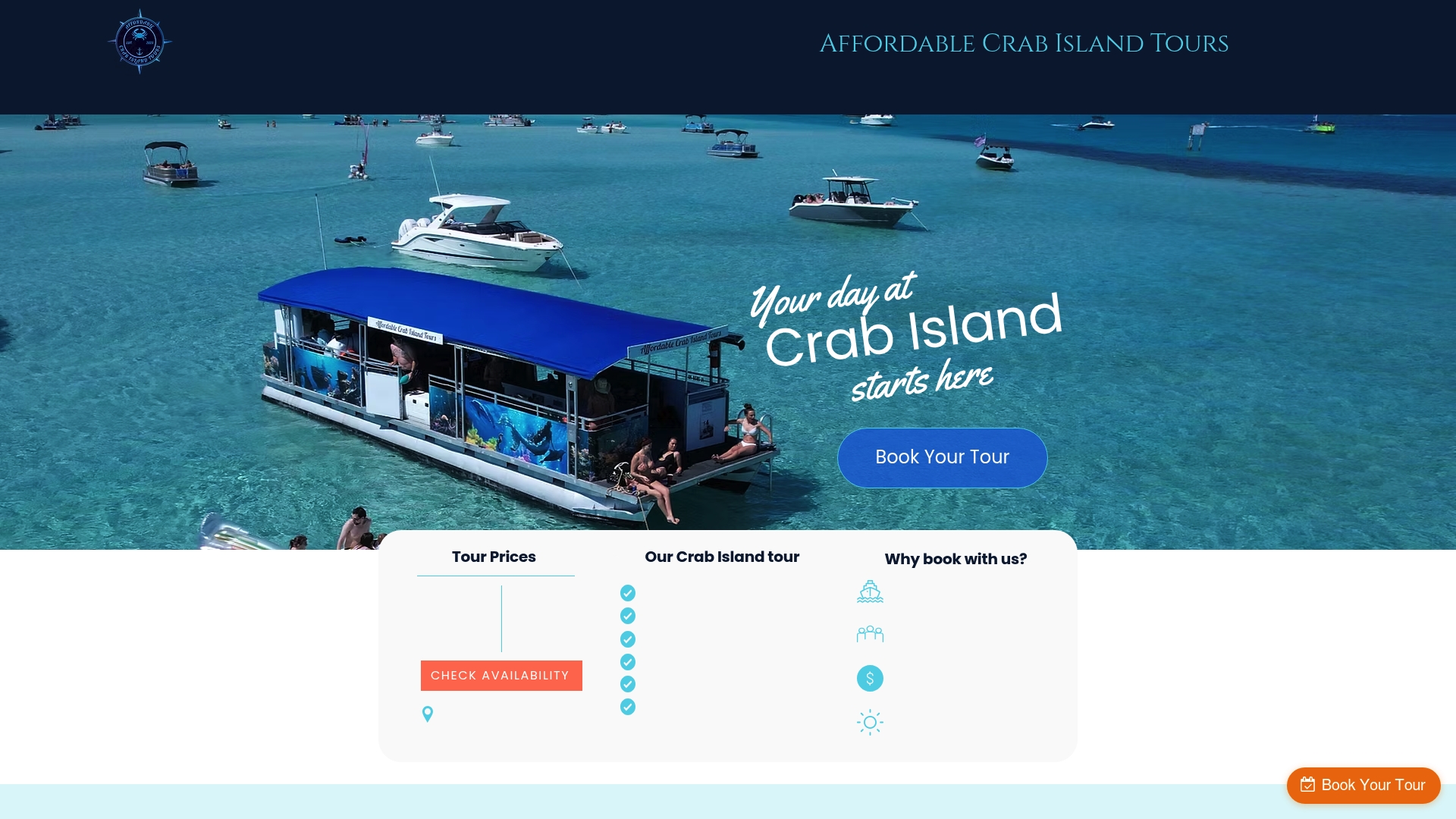
The 4-hour format covers everything most groups need for a memorable day on the water. BYOB is welcome, seating is comfortable, and the crew manages the anchoring, float deployment, and safety briefing so you do not have to think about any of it. For corporate outings, family reunions, or friend-group trips in the Destin area, this is the low-effort, high-payoff option.
For corporate groups, coordinating arrival and transport to the dock in advance keeps boarding smooth and on schedule.
Ready to lock in your date? Visit crab-island-tours.com to check availability and start your booking.
Useful sources for further planning
Chicago Architecture Center River Cruise: Solid example of clear meeting-point and pre-boarding instructions; useful for understanding what good operator communication looks like.
Pontoon Saloon Private River Cruise, Nashville: Multi-vessel private cruise operator with up to 130 guests; good reference for final headcount policies and coordinator-led large events.
Chesapeake Water Tours Private Charters: Tiered pricing examples, gratuity pre-inclusion for corporate groups, and pre-boarding communication guidance.
Barbarosa Boat Tours, Kotor: Multi-boat convoy logistics and captain coordination for groups exceeding single-vessel capacity.
Nashville Riverboats Group Packages: Group packages for 25+ with planner-friendly logistics; useful for understanding how packaged solutions simplify itinerary planning.
Affordable Crab Island Tours: The primary booking page for guided group tours in Destin, Florida, with capacity up to 31 passengers (single vessel) and guidance for larger groups on multi-boat options.
Recommended
Comments