.png)
6–16 or 45–49: Which Crab Island Group Size Is Right for U.S. Visitors

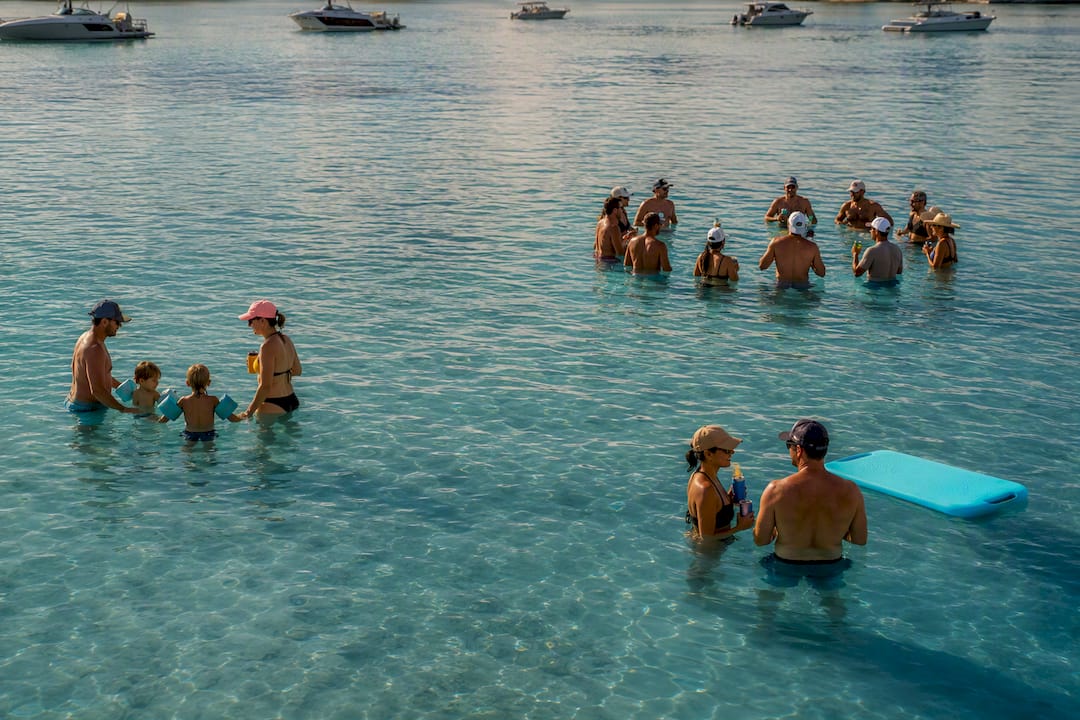
Three practical paths cover almost every group heading to Crab Island: buy individual seats on a shuttle boat (typically 45 to 49 passengers), book a private captained pontoon for small-to-mid groups (usually 6 to 16 people), or reserve a large charter for 20 to 49-plus. Solo travelers and couples do best on a shuttle. Families and small groups under 16 get more space and privacy on a private pontoon. Reunions, weddings, and parties of 20 or more need a large charter or a shuttle group rate, and operator, U.S. Coast Guard, and National Park Service rules can all shrink the number a boat is legally allowed to carry that day.
TL;DR:
Crab Island’s vessel capacity limits are strictly enforced by federal, state, and environmental regulations, including safety, environmental protection, and passenger weight limits.
Shuttle boats typically accommodate 45 to 49 passengers, with every individual, including infants and toddlers, counting against that total.
Private pontoon rentals are best for groups of 6 to 12 people, offering privacy and onboard amenities, while large charters for 16 to 49+ guests are ideal for major events but are more expensive.
Groups usually save money by choosing a private charter when exceeding 12 to 16 people, as flat rates per boat diminish per-person costs at higher capacities.
Booking well in advance is essential for large private charters during peak seasons, and operators’ policies on capacity, safety, and environmental rules must always be confirmed.
Table of Contents
How Many People Can Go to Crab Island Together?
The honest answer depends entirely on which kind of boat you’re stepping onto, because “Crab Island group size” isn’t one number. It’s a range that shifts based on vessel type, captain licensing, and how the operator interprets safety capacity that day.
Shuttle boats: the easiest single-ticket option
Shuttle boats are the closest thing Crab Island has to a bus route. You show up, buy a ticket, and board with strangers who are also just there for the sandbar. Operators commonly run 45-foot tour boats with documented capacities around 45 to 49 passengers, which makes shuttles the go-to for individuals, couples, and small parties who don’t want to coordinate an entire boat rental.
The catch: every living person counts as a passenger, no exceptions. That includes a baby asleep in a car seat. If your party is four adults and two toddlers, that’s six seats, not four.
Private captained pontoons: the sweet spot for families and friend groups
If your group is somewhere between “too big for a shuttle to feel private” and “too small to justify a full charter,” a captained pontoon is usually the right call. Rental guides commonly recommend a 22 to 24-foot deluxe pontoon for groups of about 6 to 10 people, with typical rental-pontoon capacities landing in the 6 to 12 range.
A captained pontoon gives you the whole boat: your cooler, your music, your pace. You’re not sharing space with 40 other people you’ve never met, and you’re not the one driving, which matters more than most first-timers expect once the current picks up near the anchorage.
Large charters and party boats: built for the 20-to-49 crowd
Weddings, birthdays, and family reunions push past what a pontoon can comfortably hold. That’s where larger charters come in. Operator listings show private charters commonly running 16 to 32 people, with some larger charter options advertised up to around 49 passengers for bigger events.
These bookings work differently than a shuttle ticket. You’re not paying per seat. You’re paying for the whole boat, which changes the math significantly once your group crosses roughly a dozen people (more on that below).
Self-drive rentals and jet skis: fun, but capacity-limited
Renting your own pontoon or a jet ski keeps things flexible, but it comes with real constraints. Self-drive rental pontoons max out around the same 6 to 12 range as captained versions, and most rental companies require a valid driver’s license, a security deposit, and sometimes a boating safety card depending on age. Jet skis are a two-person-per-craft proposition at most, which makes them a poor fit for anyone trying to move a group rather than a couple.
Here’s how the options stack up at a glance:
Shuttle boat seat: roughly 45 to 49 total passengers per trip, booked individually
Captained private pontoon: roughly 6 to 16 people, booked as one private group
Small-to-mid charter: roughly 16 to 32 people, whole-boat booking
Large charter or party boat: up to roughly 49 passengers, used for weddings and reunions
Self-drive pontoon rental: roughly 6 to 12 people, license and deposit required
Jet ski: 1 to 2 riders per craft
If your group is under 16, a private pontoon almost always beats splitting a shuttle in terms of comfort. If it’s over 20, you’re choosing between a large charter and buying a block of shuttle seats, and the right call usually comes down to budget and how much you value having the whole boat to yourselves.
Why Crab Island Limits Group Size and Boat Capacity
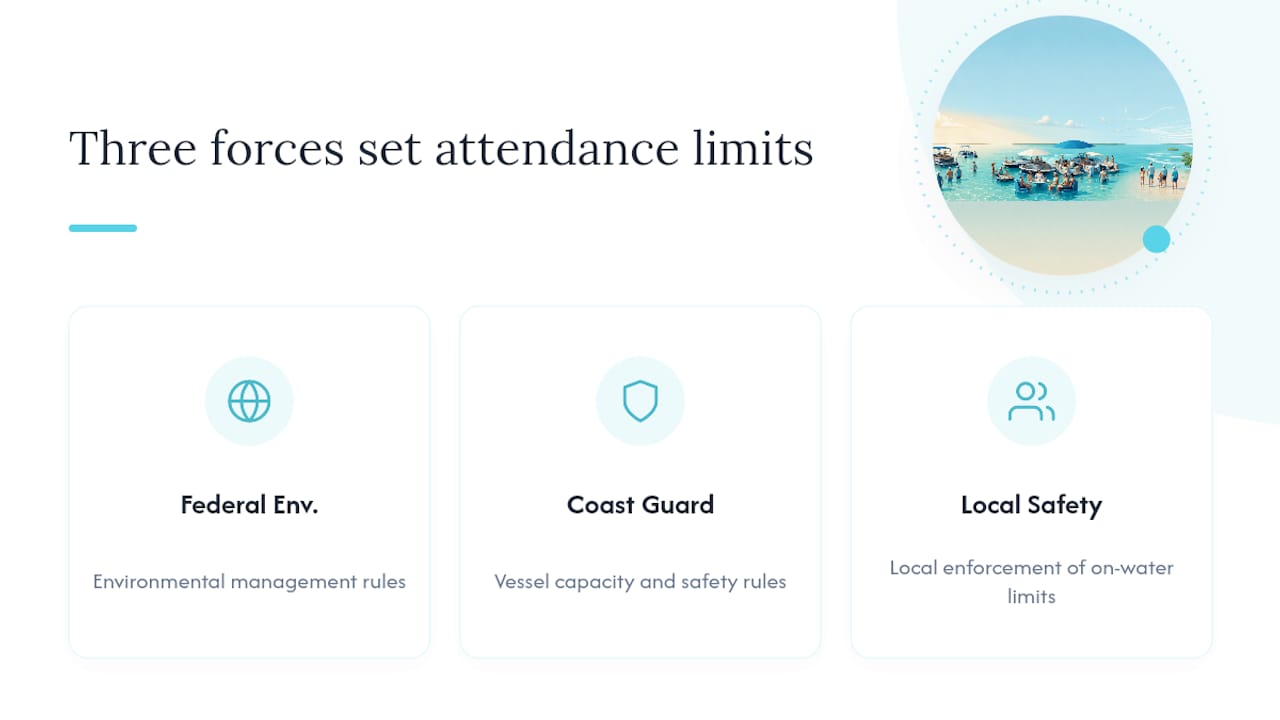
The number painted on the side of a boat isn’t arbitrary, and it isn’t the only ceiling on how many people can gather at Crab Island on a given day. Three separate forces set the real limits: federal environmental management, Coast Guard vessel rules, and local safety enforcement.
NPS management zones and seagrass protection
Crab Island sits inside waters managed under the Gulf Islands National Seashore General Management Plan, which designates the area under zones including “Natural Settings with Dispersed Recreation” and “Seagrass Bed.” That second designation matters more than most visitors realize. Seagrass beds are living habitat, not just scenery, and dense anchoring can tear them up over a season of heavy traffic.
That’s the quiet reason operators stagger drop-offs, rotate anchor spots, and avoid clustering dozens of boats on top of the same patch of grass. It isn’t just courtesy. It’s management policy working its way down to how your captain positions the boat.
Coast Guard capacity rules operators can’t bend
Every commercial vessel operating out of Destin carries a U.S. Coast Guard documented capacity, and that number is fixed regardless of how badly a group wants to squeeze in one more person. Operators have to count every rider, including infants, because the capacity plate on the hull reflects total weight and safe operation limits, not a rough headcount.
This is why a shuttle operator will turn away a family of seven trying to buy six tickets and carry a lap infant for free. It’s not pettiness. It’s federal law tied to the vessel’s certificate.
Local safety realities: currents, drownings, and crowding
Crab Island’s sandbar feels calm, but the water around it isn’t uniformly safe. East Pass, the channel connecting the bay to the Gulf, carries a strong current that has been tied to drowning incidents over the years, and local waterway safety presentations flag it as an ongoing hazard zone.
Okaloosa County’s own waterway safety materials describe hundreds of boats converging on Crab Island on peak weekends and recommend leaning on commercial operator coordination rather than uncoordinated private traffic to manage both safety and environmental impact. That’s a striking number for a sandbar that’s only accessible by water, and it’s a big part of why organized events increasingly need to work through licensed operators instead of just showing up with a flotilla of private boats.
Quick fact: County officials have cited hundreds of vessels gathering at Crab Island during peak periods, prompting recommendations for coordinated commercial operator management rather than unregulated private convergence.
Alcohol, anchoring, and event permit rules
Most shuttle and charter operators prohibit selling alcohol on board, though passengers can typically bring sealed beverages of their own. Add to that anchoring restrictions tied to the seagrass zones, and you get a picture of why large organized gatherings, sometimes nicknamed “takeovers” in local news coverage, now draw advance planning from safety agencies across counties. If you’re planning something big, working with a licensed operator who already knows the permit landscape saves you from finding out about a restriction the hard way, mid-event.
Shuttle Tickets vs. Charter Rentals: What Your Group Will Actually Pay
The math changes fast depending on whether you’re buying individual seats or renting a whole boat, and getting this wrong is the single most common planning mistake groups make.
The basic tradeoff
Shuttle tickets are priced per person, so cost scales in a straight line: eight people pay for eight seats, 24 people pay for 24 seats. A private charter, by contrast, is a flat rate for the whole boat regardless of exactly how many people fill it up to the vessel’s limit. That flat rate gets cheaper per person the more people you bring, up to capacity.
Here’s roughly how that plays out:
8 people: individual shuttle tickets are usually the cheaper, simpler option since you’re nowhere near the point where a charter’s per-person cost drops below ticket price
16 people: this is close to the crossover point where a charter’s flat rate starts beating shuttle tickets on a per-person basis, especially for groups that want to stay together as one unit
24 people: a mid-size charter almost always wins here, both on cost per person and on not having to coordinate 24 separate ticket purchases
40 people: you’re now looking at a large charter or a coordinated shuttle group booking, and per-person cost tends to be lowest of all at this scale, assuming the operator can accommodate the full group in one trip
That crossover point, generally somewhere between 12 and 16 people, is worth remembering. Below it, individual tickets are simpler. Above it, a charter usually delivers better value and far less logistical headache once everyone’s trying to arrive at the dock at the same time.
Costs beyond the base price
A few extra line items catch groups off guard:
Fuel surcharges on longer charters, especially during peak summer demand
Gratuity for the captain and crew, which is customary and appreciated even though it’s rarely built into the quoted price
Deposits to hold a charter date, usually required well before the trip
Event permit fees if you’re coordinating a large gathering like a wedding or milestone reunion that involves multiple vessels or shore coordination
Booking timing matters more than people expect
Large charters need longer lead time than a same-week shuttle ticket. Booking guidance for sizable private events commonly recommends reserving 6 to 12 months ahead for weddings or large celebrations, particularly if you want a specific date during peak summer season when boats book out fast.
Pro Tip: If your group is hovering right around 14 to 16 people, get quotes for both a charter and individual shuttle seats before deciding. The crossover point shifts slightly by operator and season, and a five-minute phone call can save real money either direction.
How to Pick the Right Fit for Your Group
Run through this before you book anything, in roughly this order:
Count your actual passenger breakdown. Adults, kids, and infants all count toward vessel capacity, so know the real number before you call anyone.
Decide how long you want to anchor. A quick two-hour visit fits a shuttle rotation fine; an all-afternoon hang calls for a private booking where you’re not on someone else’s schedule.
Confirm restroom needs. Larger boats and some shuttles carry onboard restrooms; many smaller rental pontoons do not, which matters a lot with young kids or older relatives.
Check mobility access. If anyone in your group has trouble climbing onto a boat or stepping down into shallow water, ask specifically how the operator handles boarding and disembarking.
Ask about BYOB policy. Most operators don’t sell alcohol on board but allow sealed beverages you bring yourself, so plan your cooler accordingly.
When you call an operator, ask these questions directly:
What’s the boat’s documented U.S. Coast Guard passenger capacity, and does that number include children?
Is there a restroom on board, or will we need to plan around not having one?
How many life jackets are on the boat, and do you carry child-size ones?
Do you drop passengers off and leave, or does the captain stay with the group the whole time?
What’s your policy if our group ends up a few people over what we originally booked?
If an operator can’t answer the capacity or life-jacket questions clearly, treat that as a red flag and look elsewhere. Groups with young children or older adults should generally lean toward a captained option with a restroom on board rather than a bare-bones rental, since Crab Island’s water isn’t always as calm as it looks from the dock.
What to Expect Once You’re On the Water
A typical Crab Island outing runs about four hours total once you factor in transit time both ways and anchored time at the sandbar itself. Most of that four hours is spent floating, wading, and hanging out in waist-deep water, not moving.
Shuttle operators are legally required to stay with the group they brought out. They can’t drop passengers off and leave, and they can’t sell alcohol on board, though bringing your own sealed drinks is standard practice. Larger boats commonly include an onboard restroom, which smaller rental pontoons typically lack entirely.
Storage is limited but workable:
Small to medium coolers usually fit under bench seating
Floats and snorkel gear, when included, are typically stowed at the back of the boat until you’re anchored
Personal items should stay in a dry bag or waterproof case, since splashes are constant once people start swimming
For larger groups, coordination at the sandbar itself becomes the real logistics challenge. Operators managing bigger charters typically designate a pickup window and keep a headcount system so nobody gets left floating when it’s time to head back in.
What Ten Years on Destin’s Water Actually Teaches You
Most guides treat group size as a math problem: count your people, match a boat, done. That undersells how much the type of day you want should drive the decision, not just the headcount. A family with three kids under ten and grandparents in tow needs something entirely different from four friends turning 30 who want to float with a speaker and not think about anything.
The conventional wisdom says bigger groups should just charter a bigger boat. Sometimes that’s backwards. A group of 20 people who don’t all know each other well often has a better day split across two smaller, calmer pontoons than crammed onto one large charter where half the group ends up on the far end of the boat from everyone else. Group size and group experience aren’t the same thing.
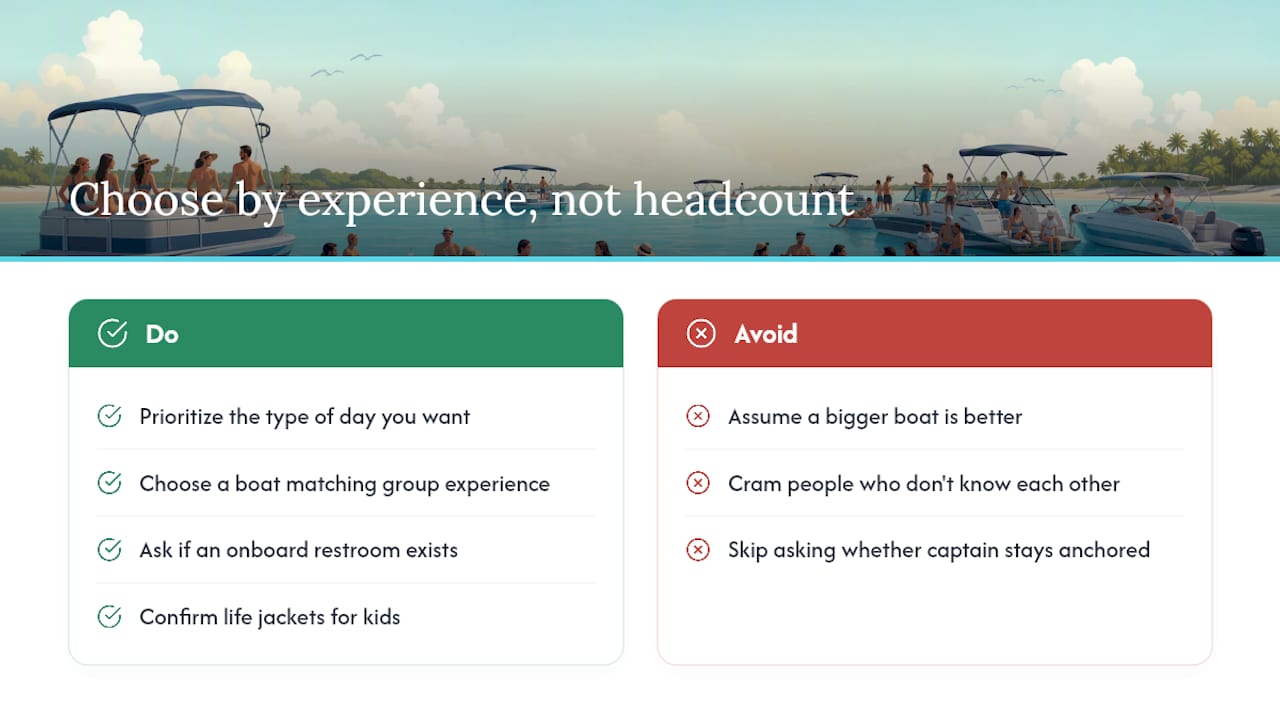
Troy has spent years on Destin’s water watching this play out, and one pattern shows up constantly: the trips that go sideways aren’t usually the ones with the wrong-size boat. They’re the ones where nobody asked about the restroom situation, the life jacket count for kids, or whether the captain actually stays anchored with the group the whole time. Some operators build their scheduled outings around that exact gap, comfortable seating for groups up to 31, an onboard restroom, floats and gear included, and a captain who runs safety briefings before anyone hits the water. That’s not a luxury add-on. It’s the difference between a relaxed afternoon and a stressful one.
If there’s one underrated truth here: the right group size isn’t the biggest boat you can fill. It’s the boat that matches how your specific group actually wants to spend four hours on the water.
— Troy
Book a Stress-Free Group Trip With Affordable Crab Island Tours
Affordable Crab Island Tours is the low-hassle alternative to piecing together a rental pontoon, a separate float rental, and a driver’s license check just to get your group to the sandbar. You show up, and everything else, floats, snorkel gear, an onboard restroom, and an experienced captain, is already handled.
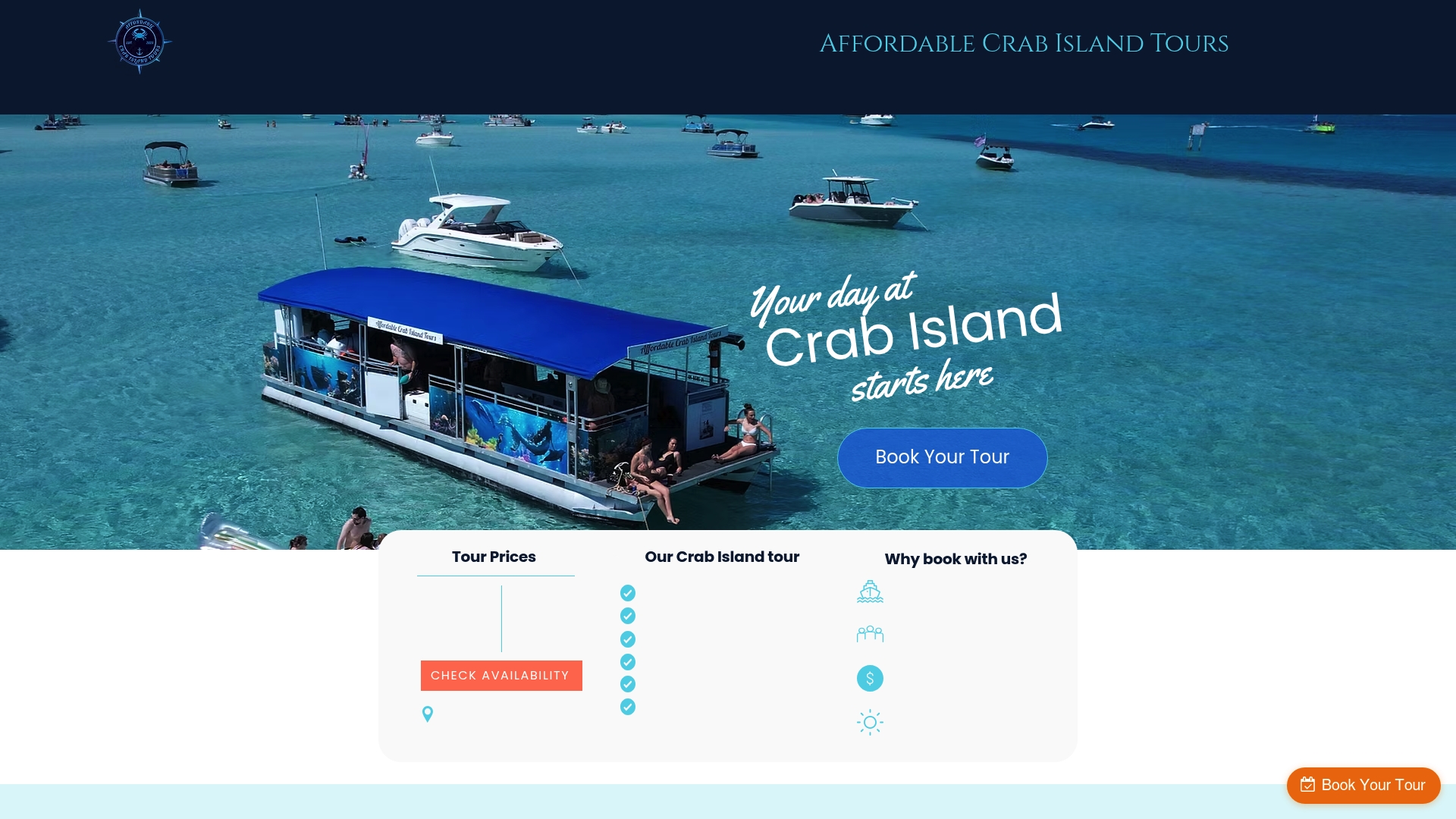
The tour comfortably seats groups up to 31 passengers, which covers most families, friend groups, and small reunions without needing to split into two boats or buy a block of individual shuttle tickets. It’s BYOB, runs a full four hours, and costs $50 to $60 per person for our Crab Island tour.
If your group is under about 30 and you want one boat, one captain, and zero logistics to manage, this scheduled tour is built for exactly that. Larger private charters still make sense for events pushing past 32 or 40 people, but for most families and groups visiting Destin, a scheduled tour hits the sweet spot between cost and convenience. Check available dates and book your spot on the Affordable Crab Island Tours booking page before peak summer weekends fill up.
Where to Verify Crab Island Rules Before You Book
A few sources are worth checking directly if you want the details straight from the source rather than a secondhand summary:
The Gulf Islands National Seashore General Management Plan for the official zoning and seagrass protection language
Okaloosa County’s waterway safety presentation for local safety data and management recommendations
Sources
FAQ
How Much Does Crab Island Cost Per Person?
Pricing varies by operator and vessel type, and Affordable Crab Island Tours’ scheduled outings run $50 to $60 per person for a four-hour tour with floats, gear, and an onboard restroom included. Private charters price differently, as a flat rate for the whole boat rather than per seat.
How Big Is Crab Island?
Crab Island is a large, shallow sandbar area in Destin’s harbor, big enough that hundreds of boats can anchor there on a busy weekend, though it’s not an actual island you can walk onto from shore. It’s accessible only by boat, which is why shuttle and charter services exist in the first place.
Is Crab Island Worth the Money?
For most visitors, yes. A calm, shallow sandbar with clear water, floating amenities, and a social atmosphere is hard to replicate elsewhere in Destin, and a scheduled tour like Affordable Crab Island Tours’ four-hour outing keeps the cost predictable without the hassle of arranging a private rental.
Can You Swim at Crab Island?
Yes, the sandbar itself sits in shallow, calm water that’s ideal for wading and swimming, though the surrounding channel and East Pass carry stronger currents that have been tied to drowning incidents. Stick close to anchored boats and designated swim areas rather than drifting toward open channel water.
What Counts as a Passenger for Boat Capacity?
Every living person counts toward a boat’s documented capacity, including infants and small children, regardless of whether they’re sitting on a lap. Confirm with your operator ahead of time how they handle child seating so your group isn’t caught short at boarding.
Recommended
Comments