.png)
4 Hour Guided Tours Let Parents Skip Car Seats on Destin Boats

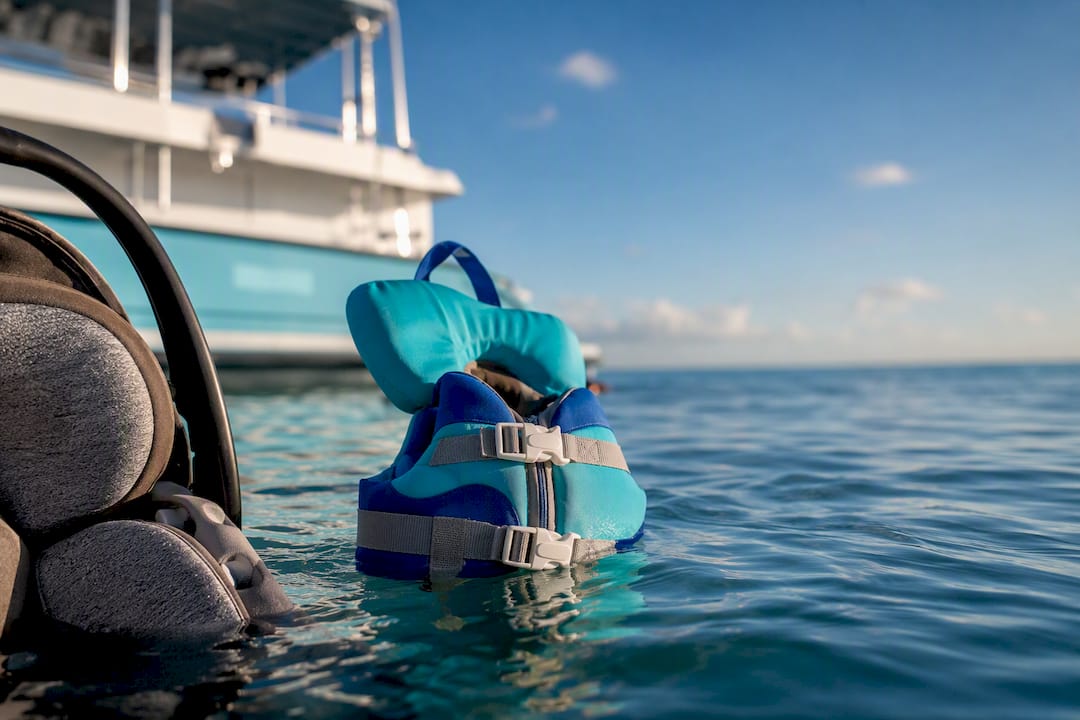
Car seats do not belong on a boat. They have no seatbelt to lock into, no marine-rated flotation, and they sink instead of float if a child ends up in the water. The safe move for any infant heading out on Destin waters is a properly fitted, U.S. Coast Guard approved life jacket, paired with a stable, family-friendly vessel. A guided outing like the ones run by Affordable Crab Island Tours removes most of the guesswork, since experienced captains and onboard safety gear are already part of the trip.
TL;DR:
Car seats sink and offer no flotation, making them unsafe for water safety and unsuitable as child restraints during boat trips.
USCG-approved life jackets with proper fit and a crotch strap are mandatory for infants, regardless of age, and must be tested before the trip.
Wide, stable boats like pontoons or catamarans reduce motion hazards and are recommended over speedboats when traveling with infants.
Guided tours with experienced captains handle safety, anchoring, and logistics, alleviating parental stress and minimizing risks during Crab Island trips.
Proper planning, including checking for onboard restroom, infant PFD availability, shade, and placement, is crucial for a safe and comfortable family boat outing.
Table of Contents
Why Car Seats Are Unsafe on Boats
A car seat is engineered for one job: keeping a child stable in a five-point harness during a car crash, anchored to a LATCH system or seatbelt. None of that exists on a boat. There’s no LATCH anchor on a pontoon bench, no shoulder belt threading through a catamaran seat, and no crash-tested frame designed to handle a wave instead of a windshield.
Sea Tow Foundation ran a demonstration that should end this debate for good: when a car seat with a weighted infant dummy went into the water, it sank. A dummy wearing a properly fitted life jacket, dropped in right next to it, floated free immediately. That single side-by-side comparison is the clearest evidence available that a car seat offers zero flotation benefit and can actively work against a child in the water.
Safe Kids Worldwide makes the same point from a different angle: car seats are not a substitute for life jackets, full stop. Their guidance treats a properly fitted PFD as the baseline safety requirement for any infant on or near water, not an optional upgrade.
There’s also a practical angle that gets less attention. Boat owners on forums like iBoats have noted that even bolting a car seat down as generic seating (not for flotation, just as a place to sit) creates problems. Marine environments corrode metal hardware fast, and car seat padding absorbs saltwater and holds moisture, which turns into mildew within days. It’s not built for that environment, and it wasn’t designed to be.
The immediate risks of using a car seat on a boat:
No flotation. It sinks, taking the child’s weight down with it.
No secure mounting point on most vessels, so the seat can shift or tip during normal wake and wave action.
No seatbelt system on the boat to lock the seat in place, unlike a car’s LATCH anchors.
Corrosion and saltwater damage degrade the seat’s structural integrity over time, even if it’s never involved in an incident.
False sense of security. Parents may assume the seat protects against a fall or capsize when it does the opposite.
Statistic callout: In the Sea Tow Foundation’s demonstration, the car seat sank to the bottom of the test pool within seconds, while the life-jacketed dummy floated at the surface without assistance. That’s the entire argument in one image.
The takeaway isn’t complicated. A car seat solves a car problem. A boat presents a water problem, and only a flotation device solves that one.
What U.S. Safety Rules Say About Kids on Boats
The Coast Guard and Safe Kids don’t leave much room for interpretation here: every child on a boat needs a properly fitted, USCG-approved life jacket, and “properly fitted” is doing a lot of work in that sentence. A jacket that’s too big will ride up over an infant’s head in the water. One that’s too small won’t keep the airway clear. Safe Kids specifically calls out the crotch strap as a non-negotiable feature for infant vests, since it’s what keeps the jacket from sliding off entirely if a baby ends up face down.
Weight is the sizing metric that matters, not age. Infant life jackets are typically rated for babies under a certain weight appropriate for infants, and a vest that fits a chunky 6-month-old won’t necessarily fit a lean 10-month-old. Try it on before you leave the dock, not after you’re already on the water.
Operators running charters and rental fleets out of Destin generally follow a consistent set of practices, even though specific requirements can vary by company:
Safety briefing before departure. A captain or crew member should walk through life jacket locations, sizes, and how to secure them properly.
Infant and child-sized PFDs on board. Ask specifically whether infant sizes (under 30 lbs) are stocked, since not every boat carries them by default.
Life jackets required for young children while underway. Many operators require young children to wear a PFD any time the boat is moving, not just during rough water.
Clear headcount policies. Some tours count infants as a passenger for capacity purposes even if they ride for free or at a reduced rate, which affects how many people (and how much gear) fits comfortably on board.
Visible, accessible storage for adult and child PFDs, so a jacket can be grabbed and fitted quickly if conditions change.
Rental companies and tour operators aren’t just being cautious for the sake of it. A local safety rules breakdown for Crab Island trips makes clear that confirming infant PFD availability and asking about the crew’s safety briefing process is one of the most useful questions a parent can ask before booking anything. If an operator can’t answer clearly, that’s a signal to look elsewhere.
Better Seating and Gear Options Than a Car Seat
Once you’ve accepted that the car seat stays in the car, the next question is obvious: what actually works instead? The answer breaks down into three categories, and each has a different job.
Infant and child life jackets are the non-negotiable piece. Look for USCG Type II or Type III designations built for infant weight ranges, with a collar that keeps the head upright and a crotch strap that prevents the jacket from riding up. Grab the collar and lift gently. If the jacket slides up past the chin, it’s too loose. Bright colors matter too. Orange and yellow are easier to spot in open water than navy or gray.
Marine-grade baby seats, like the SearocK baby seat, give infants a comfortable, shaded place to sit while the boat is anchored. These typically use a five-point harness and hang or clip into place, which makes them genuinely useful during a swim break at Crab Island when the boat isn’t moving. The catch, and it’s an important one, is that most manufacturers explicitly warn against using them while the vessel is underway. They’re a rest-and-shade solution, not a substitute for a life jacket during transit.
Fixed boat seating rounds out the picture. Wide pontoon benches and catamaran-style seating are built for stability, with low centers of gravity and enough width that an adult can sit with an infant securely in their lap or right beside them. This is where most families end up spending the bulk of the trip: an adult holding the baby, life jacket on, seated low and centered on a wide bench rather than perched near the rail.
A few do’s and don’ts worth keeping in mind:
Do hold an infant securely on your lap during any motion, rather than setting them down loose on a bench seat.
Do keep the baby’s life jacket on any time the boat is moving, even at slow speed.
Don’t rely on a marine baby seat as a safety device while underway. It’s for comfort at anchor.
Don’t assume a car seat converts into a “boat seat” just because it has straps. It doesn’t have marine flotation or a mounting system built for water.
Do position seating away from the edges and toward the center of the vessel for the most stable ride.
Pro Tip: Use the marine baby seat during the anchored swim stop at Crab Island, when the boat isn’t moving and everyone’s in and out of the water. Switch back to holding your infant, life jacket on, the moment the engine starts up again for the ride back.
Choosing a Family-Friendly Boat or Tour for Crab Island
The vessel type matters more than most first-time visitors expect. Wide, flat-decked boats designed for stability, like pontoons and wide-beam catamarans, handle chop and wake far better than narrow speedboats or deep-V hulls. That stability translates directly into comfort for an infant who can’t brace themselves the way an adult or older kid can.
Before booking anything, confirm these details directly with the operator:
Onboard restroom. A 3 to 4 hour outing with an infant almost always means a diaper change at some point. Not every boat has one.
Infant and child life jackets included. Ask specifically about sizes for babies under 30 pounds, not just general “kids’ sizes.”
Shade coverage. A bimini top isn’t a luxury for a family with a baby. It’s the difference between a comfortable trip and an overheated, sunburned one.
Captain experience and communication style. A captain who briefs safety clearly and checks in with families throughout the trip makes a real difference when you’re managing an infant on unfamiliar water.
Distance and transit time to Crab Island. Shorter transit means less time exposed to wake and motion before you’re anchored and calm.
Passenger capacity limits. A boat that’s not overcrowded gives you more room to hold, shift, and settle a fussy baby.
Local pontoon rental listings around Destin commonly advertise 24-foot boats with bimini tops, infant and child life jackets, and short runs out to Crab Island, which gives you a sense of the baseline features to expect from a reputable operator.
The bigger decision is private rental versus a guided tour, and the honest answer is that it depends on your comfort level and how much you want to manage yourself.
A private rental puts you in the captain’s seat, literally. You control the pace, the stops, and the schedule. But you also become responsible for the safety briefing, the life jacket fitting, anchoring at Crab Island, and every other logistical detail that a first-time boater with an infant may not want to juggle alone.
A guided tour hands that responsibility to an experienced captain and crew. Someone else handles anchoring, watches the water conditions, and can help troubleshoot if your baby’s life jacket needs adjusting mid-trip. For families managing sun, hydration, feeding schedules, and a possible diaper change all at once, having an extra set of trained hands on board tends to lower the stress considerably. It’s worth weighing that against the flexibility a private rental offers before deciding which fits your family better.
Pre-Trip Checklist and On-Water Baby Care Tips
Packing for a boat day with an infant is different from packing for the beach. Water reflects sun back up at your baby from below, wind dries out skin faster than it feels like it should, and there’s no quick retreat to an air-conditioned car if things go sideways.
What to pack:
A properly fitted, USCG-approved infant life jacket (bring your own if you’re not certain the operator stocks true infant sizes).
UPF-rated clothing and a wide-brim hat, since sunscreen alone doesn’t cover an infant’s full exposure on open water.
More water and formula or milk than you think you’ll need. Heat and wind both accelerate dehydration.
An extra layer or light blanket. Wind over open water cools infants faster than it feels on land, even in Florida’s summer heat.
Extra diapers, wipes, and a change of clothes, packed in a waterproof bag.
A familiar small blanket or comfort item, useful for settling a baby during the ride out.
Safe Kids specifically flags sun exposure and temperature swings as underappreciated risks for infants on boats, on top of the more obvious drowning concerns.
Timing matters more than most parents expect. Most Crab Island outings run several hours, and that window overlaps with at least one nap for most infants under a year old. Booking a morning departure, before the midday heat peaks and around a typical nap window, tends to produce a calmer trip than an afternoon slot. A look at how tour duration interacts with a child’s nap schedule is worth reading if your baby is a sensitive sleeper.
On the water, rotate supervision if you’re traveling with a partner or another adult. One person watching the baby closely while the other handles gear, snacks, or a swim break keeps everyone from getting worn out at the same time. Boarding and reboarding at Crab Island (getting a baby off the boat and back on safely) is often the trickiest few minutes of the whole trip, so have one adult dedicated to the baby during that transition while another handles bags and floats.
Pro Tip: Plan your baby’s biggest feeding right before departure, not right after. A full, sleepy baby handles engine noise and boat motion far better than a hungry, overstimulated one.
Quick Answers to Common Parent Questions
Should I use a car seat on a boat in Destin? No. Use a properly fitted, USCG-approved infant life jacket instead. Car seats sink, lack marine mounting points, and offer no flotation benefit.
Where can I get an infant life jacket for a Crab Island trip?
Many rental and tour operators stock infant and child sizes, but availability varies, so ask before you book.
Outdoor and marine retailers in the Destin area carry infant PFDs if you want to bring your own for a guaranteed fit.
Confirm the weight range printed on the jacket. Most infant vests cover babies under 30 pounds specifically.
What should I check about renter-provided gear before trusting it?
Ask if infant sizes are available, not just general “kids” sizes, since a jacket built for a 40 pound toddler won’t fit a 15 pound infant safely.
Check that the jacket has a crotch strap, which keeps it from sliding off in the water.
Confirm the operator does a hands-on fitting demonstration, not just a verbal explanation.
Do you need a boat license to operate a rental in Destin? Florida doesn’t require a boating license for most recreational rentals, but rental companies typically require a boater safety card or a brief operator orientation for anyone born after a certain date, per state boating law. If you’re not comfortable navigating and anchoring yourself, that’s a strong argument for a guided tour instead of a self-operated rental.
Local Perspective: What a Guided Crab Island Tour Actually Offers
Some tour operators run 4-hour guided outings built around exactly the concerns this guide covers. These trips often include floats and snorkel gear, onboard restrooms, and experienced captains, with room for large groups including families and couples.
That combination solves several problems at once for a parent traveling with an infant:
No car-seat decision to make. The seating on board is fixed, wide, and stable, designed for people, not a converted automotive product.
Restroom on board means a diaper change doesn’t require cutting the trip short or improvising on the water.
Experienced captains handle navigation and anchoring, which frees parents up to focus entirely on their baby instead of splitting attention between driving and supervising.
Crew supervision during the trip adds an extra layer of awareness during critical moments such as boarding, anchoring, and swim stops.
BYOB policies and straightforward pricing keep outings simple and easy to manage for families and groups.
The whole model is built around removing logistics, not adding luxury for its own sake. That’s a meaningfully different pitch than “book a boat and figure it out,” which is often what a first-time visitor to Destin is actually facing when they start looking at private rental listings.
What Florida Law Actually Requires for Kids on Boats
Florida law requires children under 6 years old to wear a USCG-approved Type I, II, or III life jacket while on a boat under 26 feet that’s underway, with limited exceptions for enclosed cabins. That single rule covers most of the pontoons, catamarans, and rental boats families use around Destin and Crab Island, since the majority fall well under that 26-foot threshold.
The law focuses on age and boat length, not on the type of seating installed. There’s no Florida statute requiring or endorsing car seats as boat safety equipment, and no exception that treats a car seat as an acceptable substitute for a life jacket. The requirement is specific: an approved PFD, sized and fitted for the child’s weight, worn any time the boat is moving.
Enforcement falls to the Florida Fish and Wildlife Conservation Commission and the Coast Guard, and it’s not treated as a minor technicality. Officers checking a vessel on the water can and do verify life jacket compliance for young children, and a missing or improperly fitted PFD is a citable violation. For infants specifically, since they’re well under 6, the requirement applies automatically. Skip the car seat entirely and make sure the life jacket fits before you leave the dock, not after you notice a problem on the water.
Installing and Securing an Infant Life Jacket the Right Way
Fitting an infant life jacket takes about two minutes, but skipping steps is exactly where things go wrong. Start with the size. Infant vests are rated by weight, typically under 30 pounds, so check the tag against your baby’s current weight rather than guessing based on age.
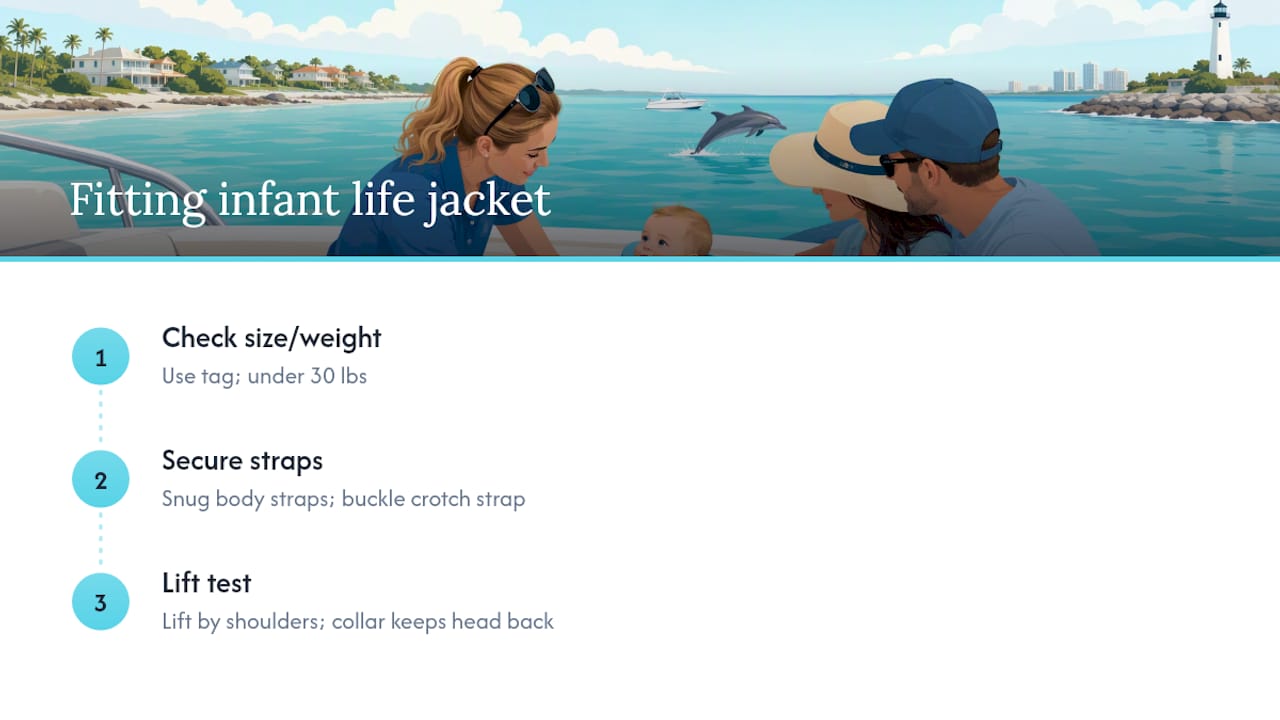
Slide the jacket on and secure the main body straps first, snug but not so tight that it restricts breathing or movement. Then buckle the crotch strap. This is the step people skip most often, and it’s the one that keeps the jacket from riding up over the baby’s head if they end up face down in the water. A jacket without the crotch strap fastened isn’t a properly worn life jacket, no matter how good the fit looks otherwise.
Test it before you leave the dock. Grab the jacket by the shoulders and lift gently. If it slides up toward the chin, tighten the straps further or size down. The collar should sit around the back of the neck and keep the head tilted slightly back and upright, which is the design feature that keeps an unconscious or startled infant’s face out of the water.
Once it’s fitted, leave it on for the entire time the boat is moving, including short transits between anchor points. Reserve any time without the jacket for calm, supervised moments at anchor, and only with an adult holding the baby directly.
Comparing Infant Life Vest Types for Boating
Not all infant PFDs are built the same way, and picking the right style matters as much as getting the size right.
Foam-filled infant vests are the most common option for babies under 30 pounds. They use rigid foam panels front and back, with a head support collar and a crotch strap. These are the standard choice for boating with infants and what most rental operators stock.
Inflatable PFDs exist for older kids and adults but are generally not recommended for infants, since they require the wearer to have some ability to self-right or signal, which an infant can’t reliably do.
Hybrid vests, combining some foam with lighter materials, show up occasionally in child sizes but are less common in true infant ranges. Stick with a fully foam-filled, USCG-approved vest labeled for your baby’s specific weight range, and skip anything marketed as a “swim aid” or “puddle jumper,” since those are training tools, not safety equipment, and they aren’t rated for open water boating.
Managing Seasickness and Motion Sensitivity in Babies
Infants and toddlers can get queasy on a boat just like adults do, though they can’t always tell you what’s wrong. Watch for fussiness that starts up specifically once the boat is moving, along with excessive drooling, unusual quietness, or spitting up more than normal.
Positioning helps more than most parents expect. Keep the baby seated low and centered on the boat, away from the bow where motion is most exaggerated, and facing forward toward the horizon rather than sideways. A view of the horizon line, even for a baby too young to consciously focus on it, seems to help settle the inner ear’s sense of motion.
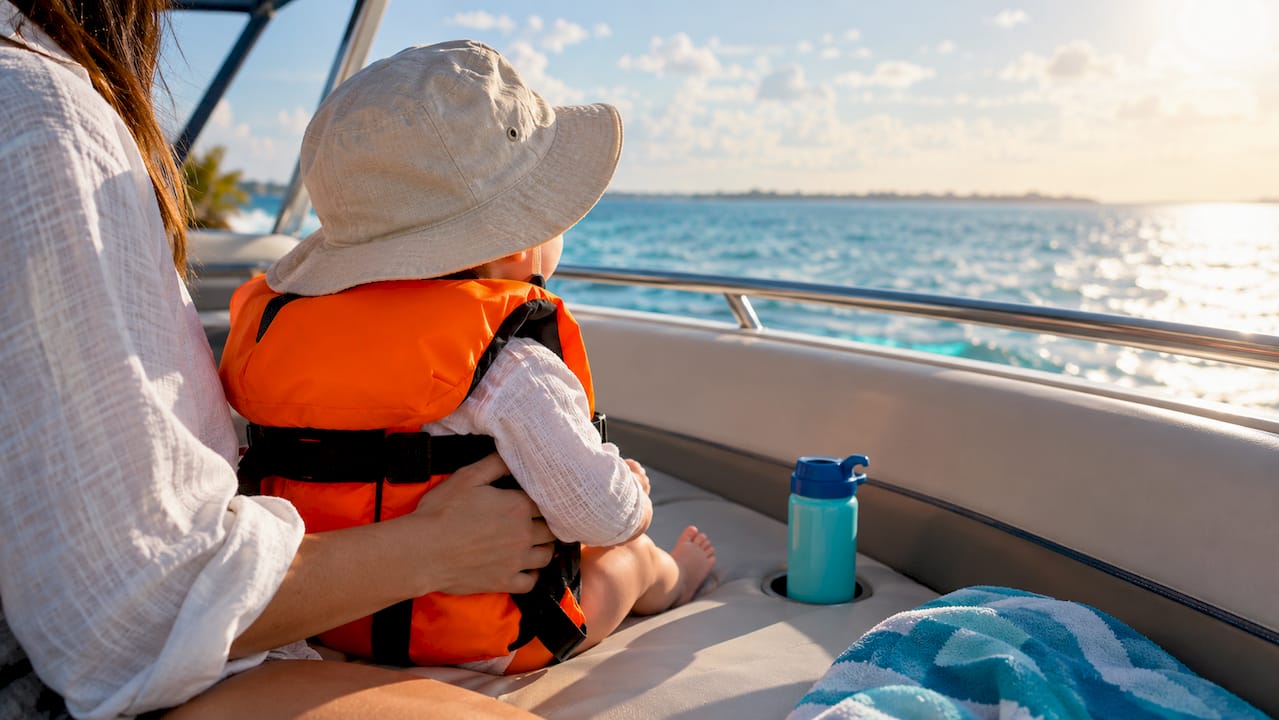
Fresh air matters too. A shaded spot with a breeze tends to work better than an enclosed cabin, which can trap heat and amplify nausea. If your baby does get sick, keep them upright rather than laying them flat, and offer small sips of water or milk once things settle rather than a full feeding right away.
Emergency Preparedness for Destin Boat Outings With Kids
A basic first aid kit belongs in your bag, not just on the boat, since operator kits vary and you know your baby’s specific needs best. Pack infant fever reducer, any prescribed medications, a thermometer, and basic wound care supplies.
Before departure, confirm where the boat’s safety equipment lives: fire extinguisher, flares, and the location of every life jacket size on board, not just the adult ones. Ask the captain directly what the plan is if weather shifts quickly, since Gulf Coast storms can build fast in summer afternoons.
Know the signs of dehydration and overheating in infants specifically: fewer wet diapers than usual, unusual sleepiness, or a lack of tears when crying. Both develop faster on open water than parents expect, given the combination of sun, wind, and reflected heat off the surface. Address them immediately by moving to shade, offering fluids, and cutting the trip short if symptoms don’t improve quickly.
What Actually Matters When You’re Boating With a Baby in Destin
Most of the advice floating around online treats car seats and boat seating like a gray area, something you weigh case by case. It isn’t. The Sea Tow Foundation’s own demonstration settles that question outright, and no amount of DIY strapping or bungee cord ingenuity changes what happens when a car seat hits the water.
Where conventional advice actually falls short is in what it tells parents to do after ruling out the car seat. A lot of guides stop at “buy a life jacket” and leave the harder logistics (restroom breaks, nap timing, who’s watching the baby during a swim stop) completely unaddressed. Those logistics are where most of the real stress on a family boat day actually comes from.
Prioritize the life jacket fit first, always. But prioritize the choice of vessel and crew second, because a stable boat with an experienced captain and a restroom on board solves half the problems a checklist alone never will.
— Troy
A Stress-Free Way to Do Crab Island With a Baby
Booking a private rental means you’re the one handling navigation, anchoring, life jacket fitting, and every other detail this guide just walked through, on top of managing an infant. A guided tour hands most of that off to someone who does it every day. Affordable Crab Island Tours runs 4-hour outings with an experienced captain, floats and snorkel gear included, and a restroom on board, all built for families who’d rather show up and relax than manage boat logistics with a baby in tow.
If you’re weighing a guided outing, confirm a few things when you book: current passenger capacity, whether infant life jackets are on board in your baby’s size, and the scheduled departure time relative to nap windows. Check available dates and reserve your spot directly through Affordable Crab Island Tours before your trip fills up.
Sources
Recommended
Comments