.png)
How Destin Became a Top Beach Destination

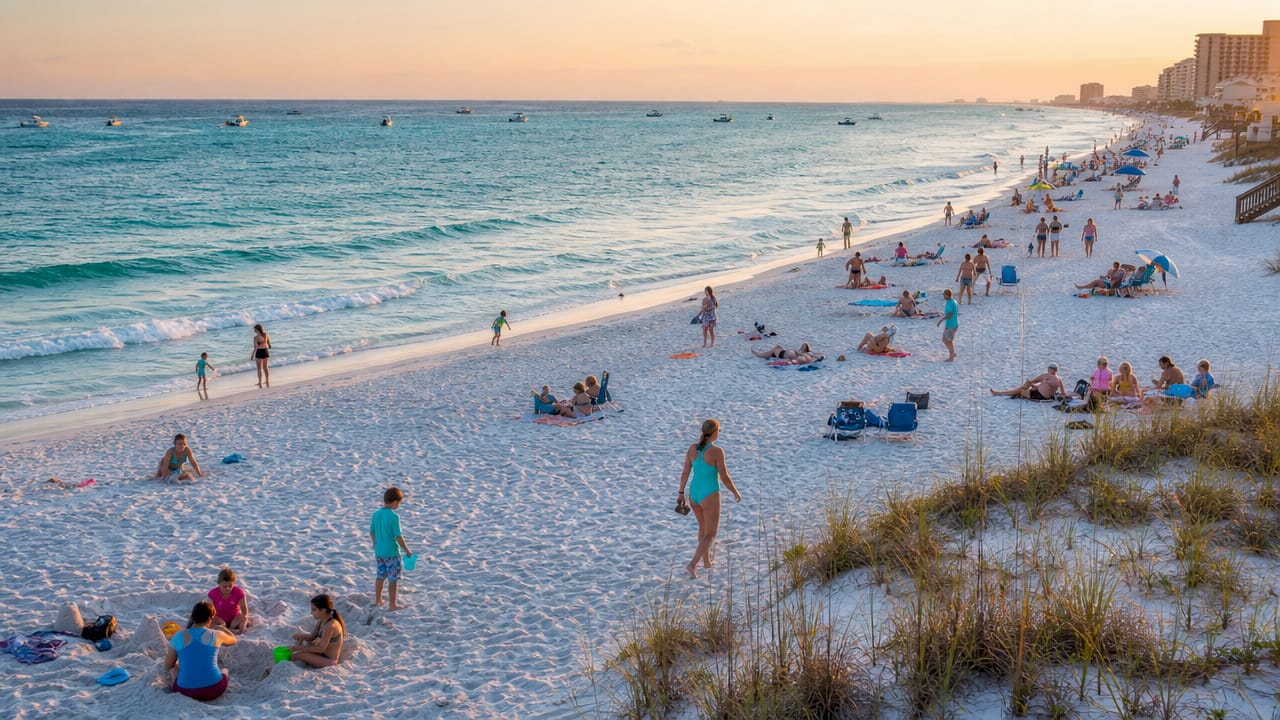
Destin is defined by a rare combination of quartz-white sand, emerald Gulf waters, and decades of deliberate tourism investment that transformed a small Florida fishing village into one of America’s most visited beach destinations. Understanding how Destin became a top beach destination requires looking at three interlocking forces: geology that no other Gulf Coast city can replicate, infrastructure that made the city reachable for millions, and cultural traditions that keep visitors returning year after year. This article unpacks each layer with specifics, not generalities.
What natural features make Destin’s beaches uniquely appealing?
Destin’s beaches are geologically distinct from nearly every other stretch of Gulf Coast shoreline. The sand is nearly pure quartz, which gives it a bright white color, a squeaky texture underfoot, and a surface that stays noticeably cooler than typical beach sand on hot summer days. Most Florida beaches contain a mix of quartz, shell fragments, and limestone particles that absorb heat and dull the color. Destin’s sand does neither.
The water color follows directly from the sand. Quartz reflects light differently than darker sediments, scattering sunlight in a way that produces the signature emerald green hue visible in nearly every photo of Destin’s shoreline. Visitors who have only seen the Atlantic or the lower Gulf often describe the color as almost artificial. It is not. It is physics working in Destin’s favor.

What separates Destin from other white-sand beaches is what lies just offshore. The Gulf floor drops 600 feet near the shoreline, and the “100-Fathom Curve” sits only about 30 minutes by boat. That depth gradient means deep-sea fishing species that require long offshore runs elsewhere are practically in Destin’s backyard. This is why the city earned the nickname “The World’s Luckiest Fishing Village” long before tourism marketing existed.
The practical implications for visitors are significant:
Cool, white sand that stays comfortable even in July heat
Emerald water clarity that makes snorkeling and paddleboarding visually rewarding
Offshore depth that supports world-class fishing without a full-day boat trip
Calm inshore waters near Crab Island and the East Pass that suit families and casual swimmers
Pro Tip: Visit Destin beaches before 9 a.m. or after 5 p.m. in summer. The quartz sand reflects heat rather than absorbing it, so the beach stays cooler longer than you expect, and the light on the water at those hours is extraordinary.
How did infrastructure drive Destin’s growth as a beach destination?
Natural beauty attracts visitors once. Infrastructure brings them back repeatedly and in larger numbers. Destin’s transformation from fishing village to resort city tracks almost perfectly with its transportation and development history.
The population data tells the story clearly. Destin’s population nearly doubled between 1930 and 1940, growing from 166 to 318 residents. That growth was modest in absolute terms but significant as a signal of early outside interest. By 2017, the permanent population had reached nearly 14,000, augmented by seasonal tourist inflows that Highway 98 made possible. Highway 98 is the primary coastal road running through Destin, and its expansion gave millions of Southeast residents a direct driving route to the beach.
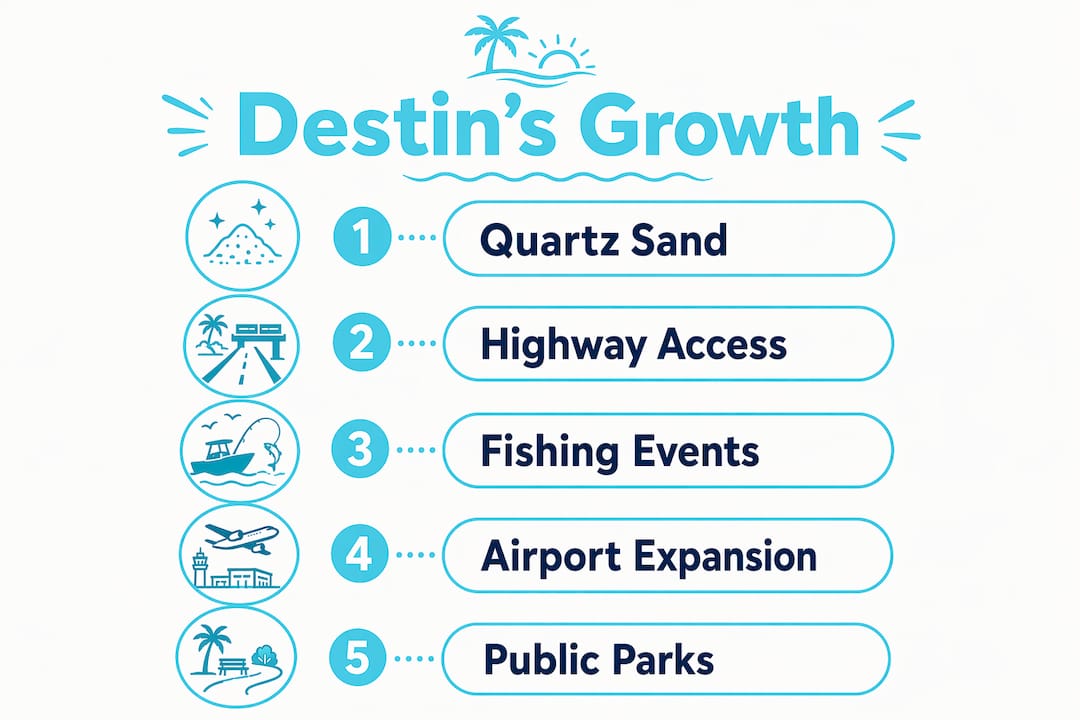
The infrastructure story accelerated in the 2020s. Destin’s regional airport received a major upgrade when Allegiant Air built an $11 million concourse that repositioned the facility from a regional connector to a national gateway. In spring and summer 2026, five new nonstop flights launched from markets that previously had no direct service to the Florida Panhandle. That shift matters because it changes who can visit. A family in the Midwest no longer needs to drive two days or connect through Atlanta to reach Destin.
The key infrastructure milestones that shaped Destin’s visitor economy:
Highway 98 expansion connected Destin to the broader Southeast road network, enabling drive-in tourism from Alabama, Georgia, and Tennessee.
Residential and hospitality development in the 1980s and 1990s added the hotels, condominiums, and rental properties that gave visitors places to stay.
Allegiant’s $11 million concourse modernized the airport experience and signaled long-term confidence in the destination.
Five new nonstop routes in 2026 opened Destin to national visitor markets for the first time at scale.
Airport improvements of this scale redefine a destination’s market from regional drive-in visitors to nationally flown-in travelers. That distinction matters for economic sustainability because it reduces dependence on any single feeder market.
What role do tourism events and culture play in Destin’s popularity?
Events convert one-time visitors into repeat visitors. Destin understood this earlier than most beach cities. The Destin Fishing Rodeo launched in 1948 and has run every October since, making it one of the longest-running fishing tournaments in the United States. It now draws over 30,000 anglers annually, with daily weigh-ins running from 10 a.m. to 7 p.m. throughout the month.
The Fishing Rodeo does something that passive beach amenities cannot. It creates a reason to visit Destin in October, a month when most beach destinations see sharp drops in traffic. Families come for the spectacle of the weigh-ins. Anglers come to compete. Restaurants and charter operators build their fall business models around the event. The result is a tourism economy that does not collapse after Labor Day.
Beyond the Rodeo, Destin’s cultural calendar includes:
Destin Seafood Festival, drawing tens of thousands of visitors each fall with local Gulf seafood and live music
HarborWalk Village events, a waterfront entertainment district that hosts concerts, fireworks, and seasonal festivals year-round
Emerald Coast Blue Marlin Classic, a high-stakes offshore fishing tournament that attracts competitive anglers and spectators from across the country
Family-friendly water parks and attractions along the Emerald Coast corridor that extend the appeal beyond beach-only visitors
The cultural layer of Destin’s appeal is not accidental. Annual events like the Fishing Rodeo smooth tourism demand across seasons, supporting a steady visitor economy that does not depend entirely on summer beach traffic. That is a structural advantage most beach destinations lack.
How do recent public investments sustain Destin’s destination status?
Destin’s most recent chapter involves public investment that improves the visitor experience without placing the full financial burden on local taxpayers. The clearest example is Norriego Point Park, a 14-acre waterfront park that opened on March 5, 2026, after decades of planning. The total project cost $15 million, with less than $200,000 coming from local taxpayer funds. The remainder came primarily from oil spill settlement money, a funding model that demonstrates how destinations can invest in public amenities without raising taxes.
The park adds public beach access, walking trails, and water access points at a location that was previously underdeveloped. For visitors, it means more free, accessible beach space in a city where private development has consumed much of the waterfront. For the city, it means a new attraction that requires no admission fee and generates economic activity through visitor spending at nearby businesses.
Investment | Details |
Norriego Point Park | 14-acre park opened March 2026, $15 million cost, under $200,000 local taxpayer funds |
Allegiant concourse | $11 million facility modernizing the regional airport for national-scale arrivals |
2026 nonstop flights | Five new routes launching spring/summer 2026, expanding national visitor reach |
Beach amenities | ADA-accessible facilities and improved public access points added across the coastline |
Tourism growth in Destin is not accidental. The region has invested steadily in clean beaches, marketing, and visitor facilities to attract both families and travelers seeking higher-end experiences. Social media visibility has amplified these investments significantly. A single viral photo of Destin’s emerald water now reaches audiences that no traditional advertising budget could have touched a decade ago.
Pro Tip: Norriego Point Park is accessible by water as well as land. If you are already on a boat near the East Pass, you can pull up directly to the park’s shoreline. It is one of the few free, public waterfront spaces in Destin with this kind of dual access.
Key takeaways
Destin’s rise as a top beach destination is the direct result of quartz-rich geology, Highway 98 access, the Destin Fishing Rodeo’s 75-year cultural anchor, and public-private investments that continue expanding capacity in 2026.
Point | Details |
Quartz sand and emerald water | Nearly pure quartz creates Destin’s signature white sand and clear green water, a geological advantage no competitor can replicate. |
Infrastructure drove growth | Highway 98 and a growing airport network expanded Destin’s visitor base from local to national scale. |
Events sustain year-round demand | The Destin Fishing Rodeo, running since 1948, keeps visitor traffic strong well beyond the summer season. |
Smart public funding | Norriego Point Park’s $15 million cost used less than $200,000 in local taxpayer funds, proving sustainable investment models work. |
Air access changes everything | Five new nonstop flights in 2026 shift Destin from a regional drive-in market to a nationally competitive destination. |
Why Destin’s success is harder to copy than it looks
Most people assume Destin got lucky with its beaches. Having spent time studying how beach destinations rise and fall, I think that framing misses the real story entirely.
The geology is real and rare. Quartz-rich sand combined with a 600-foot offshore drop is not something a city can manufacture. But plenty of beautiful beaches have stayed obscure because no one built the roads, the airports, or the events that turn natural beauty into a functioning visitor economy. Destin did all three, and it did them in sequence rather than all at once.
What strikes me most is the Fishing Rodeo. A tournament that started in 1948 and still draws over 30,000 anglers is not just a tourism event. It is a cultural institution that gives Destin an identity beyond “nice beach.” That identity is what keeps people coming back and what gives locals a sense of ownership over the destination. When residents feel proud of their city’s tourism culture rather than resentful of it, the visitor experience improves across the board.
The public-private funding model behind Norriego Point Park is also worth noting. Spending $15 million on a public park while keeping local taxpayer exposure under $200,000 is not luck. It is deliberate financial strategy. Cities that figure out how to invest in visitor infrastructure without taxing residents into opposition tend to build better destinations over time. Destin has figured that out.
The lesson for anyone thinking about where to vacation, or how destinations succeed, is that the best beach cities combine something irreplaceable with something intentional. Destin has both.
— Troy
See Destin’s waters up close with Crab-island-tours
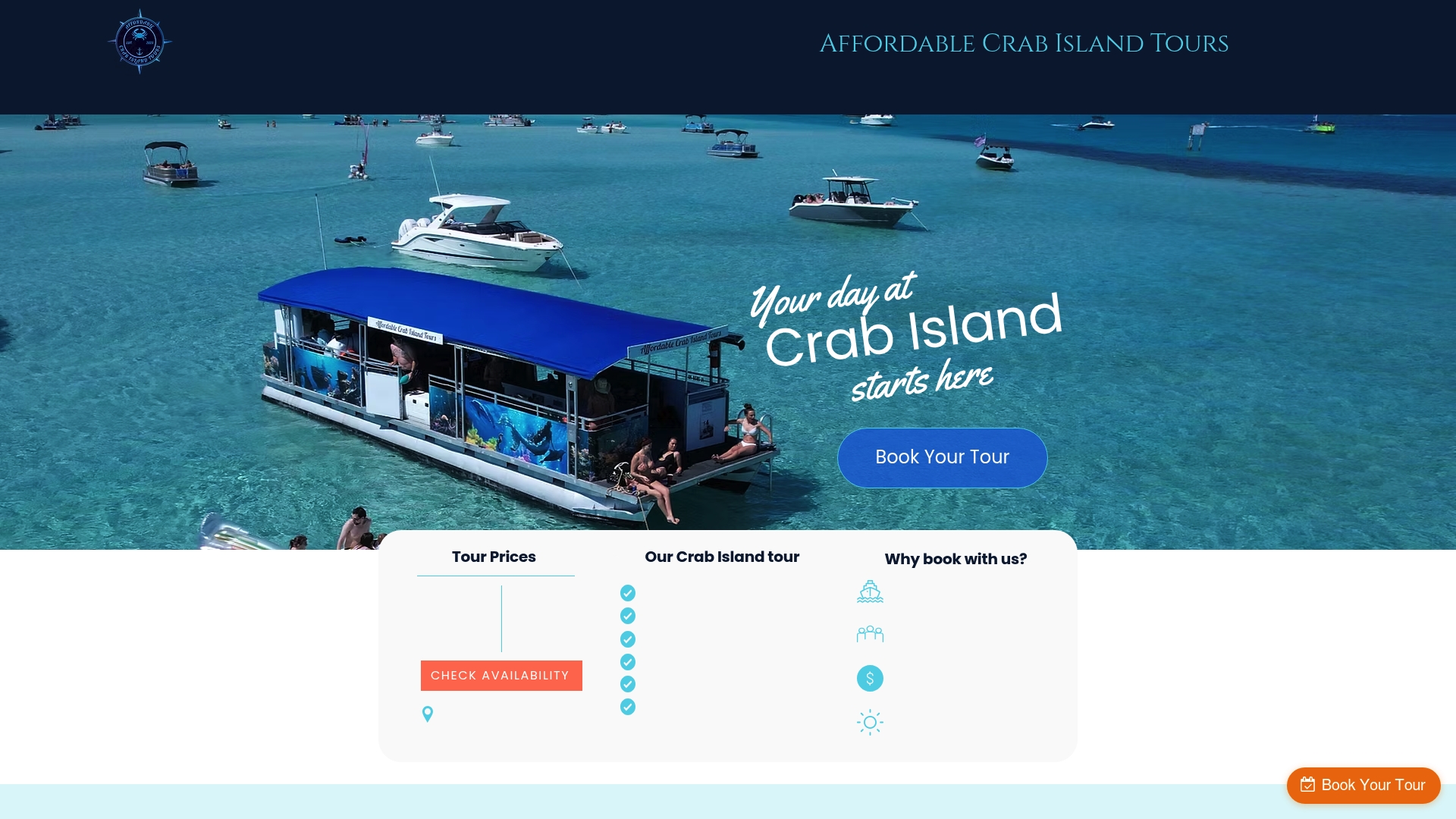
Reading about Destin’s emerald water and quartz sand is one thing. Being on the water is another. Crab-island-tours offers affordable 4-hour party boat tours to Crab Island, one of Destin’s most iconic water destinations, with floats, an onboard restroom, and experienced captains included. You show up. They handle everything else. No boat rental logistics, no hidden costs, no stress. Families, couples, and groups consistently highlight the crew’s attentiveness and the value for money in their reviews. If you want to experience what makes Destin’s waters genuinely special, this is the most straightforward way to do it. Check the full Destin tour comparison guide to see how Crab-island-tours stacks up against other local options.
FAQ
What makes Destin’s sand white and the water green?
Destin’s sand is nearly pure quartz, which reflects light rather than absorbing it, keeping the sand white and cool. The quartz particles scatter sunlight through the shallow water in a way that produces the distinctive emerald green color.
When did Destin become a popular tourist destination?
Destin’s tourism growth accelerated after Highway 98 expanded access from the broader Southeast, with the permanent population growing from 166 in 1930 to nearly 14,000 by 2017. The city transitioned from a regional fishing village to a national beach destination over roughly eight decades of infrastructure investment.
What is the Destin Fishing Rodeo?
The Destin Fishing Rodeo is an annual fishing tournament that has run every October since 1948, drawing over 30,000 anglers with daily weigh-ins. It is one of the longest-running fishing events in the United States and a major driver of fall tourism in the region.
How has Destin’s airport improved access for visitors?
Allegiant Air built an $11 million concourse at the regional airport, and five new nonstop flights launched in spring and summer 2026. These additions shifted Destin’s visitor base from primarily regional drive-in traffic to a nationally accessible destination.
Is Crab Island worth visiting in Destin?
Crab Island is a submerged sandbar in Destin Harbor where boats anchor and visitors swim, float, and socialize in shallow, calm water. It is one of Destin’s most popular water attractions and accessible by boat tour without needing to rent your own vessel.
Recommended
Comments